How to Advertise a Local Business in Melbourne
How to advertise a local business when most of your customers live within a few kilometres. Five channels compared honestly, including the ones we don't sell.
Start with where your customers live
A cafe, a plumber and a dental clinic all have the same advantage: their customers live nearby. Local advertising works when it reaches those households often enough to be remembered, at a cost the business can measure.
No single channel does everything. Below are the five we see Melbourne businesses use most, what each is good at, and where each falls short. We run letterbox drops, so read that section with that in mind.
1. Google Business Profile
This is the free listing that appears in Google Maps and the map results when someone searches for a business type in your area. For most local businesses it is the single most important thing to set up.
- Good for: people already searching for what you sell, today.
- Falls short: it only reaches people who search. It does nothing for households who haven’t thought about you yet.
- Do this: fill in every field, add real photos, post weekly and ask every customer for a review.
2. Local Facebook groups and community pages
Most Melbourne suburbs have a community group where residents ask for recommendations. A genuine reply from a local owner can bring work for free.
- Good for: trust and word of mouth, especially for trades and services.
- Falls short: many groups limit business posts, and results depend on someone asking at the right moment.
- Do this: follow each group’s rules, answer questions helpfully, and let happy customers recommend you.
3. Signage and your shopfront
For a shop, cafe or clinic, the building itself is advertising. Clear signage, an A-frame on the footpath and a window that shows what you do reach everyone who walks or drives past.
- Good for: businesses on a busy strip with passing foot traffic.
- Falls short: it only reaches people who pass, and does little for trades or mobile services.
- Do this: check your council’s rules on footpath signs before buying one.
4. Google Ads
Paid search ads put you at the top of the results for chosen search terms, and you pay when someone clicks. Ads can be limited to a radius around your business.
- Good for: urgent needs such as emergency plumbing or locksmiths, where people search and call at once.
- Falls short: costs per click vary widely by industry, and the calls stop when the budget does.
- Do this: start small, track calls from the ads, and stop keywords that bring clicks but no customers.
5. Letterbox drops
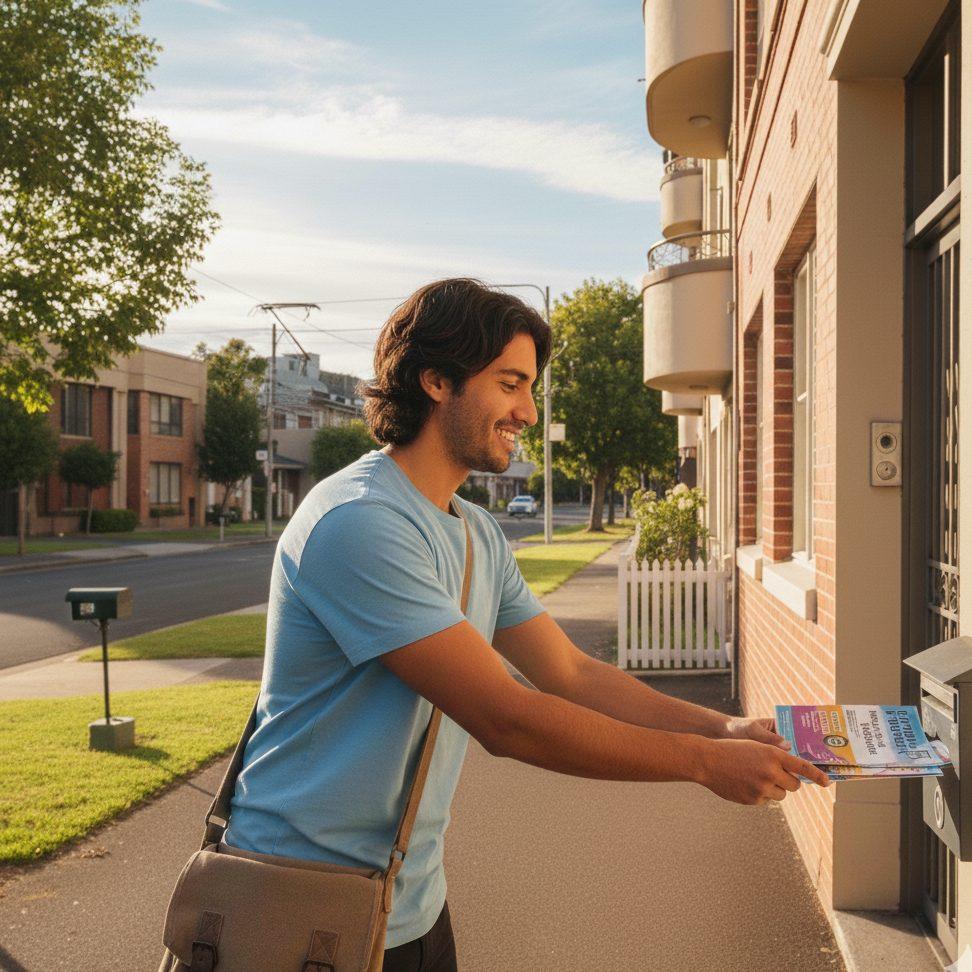
A flyer delivered to every home in chosen streets reaches households whether or not they search, scroll or walk past. It is the channel we run, so here is the honest version.
- Good for: businesses with a clear local catchment, such as trades, takeaway, clinics, groomers and agents.
- Falls short: a single drop rarely builds a business. Results come from a clear offer, the right streets and repeat drops.
- Do this: start with 1,000 to 2,500 homes, use an offer code only the flyer carries, and repeat in the streets that respond.
Our drops are delivered on their own and GPS-tracked, from 1,000 flyers. The letterbox drop cost page covers quantities from 1,000 to 20,000 flyers.
Putting it together
A sensible order for most businesses: set up the Google Business Profile, collect reviews, join the local groups, then test one paid channel at a time. Give each channel a few weeks and a way to measure it before judging it.
For more on local business advertising ideas by trade, see our pages for plumbers, restaurants and cafes and real estate agents, or the local business flyers hub.
Letterbox drop advertising, compared with the other options
Letterbox drop advertising is one of the five local channels this guide compares. It is not a social post and it is not a printed ad on someone else’s flyer. Your flyer goes in the letterbox on its own. That is what we mean by exclusive delivery.
Letterbox marketing, or letterbox advertising, is worth considering when your customers live in a defined set of streets, a suburb, a radius around a shop, or the area around a listing. It will not replace a Google Business Profile, and it will not help if you need to reach another city. If you decide a drop is the right channel, use the letterbox drop page to book, and the letterbox drop cost page for starting prices ($180 per 1,000 flyers).
How to distribute flyers in a neighbourhood
If you already have printed flyers, a letterbox drop is how we get them to the homes you choose in Melbourne’s south-east and east. You supply the flyers. We plan the streets, deliver each flyer on its own (never bundled), and send a GPS report of the run. Starting prices are on the letterbox drop cost page ($180 per 1,000 flyers). To book, use the flyer distribution or letterbox drop page.
Local advertising in Melbourne's south-east
If a letterbox drop fits your business, we cover 56 suburbs across south-east and eastern Melbourne. Every drop is exclusive, with no other advertisers’ flyers in the run, and you get a GPS map of every street covered.
Want to test a letterbox drop?
Tell us your business and the streets around you. We'll quote with a quick turnaround.
- Coverage across 56 suburbs
- High-conversion letterbox marketing
- Helps you acquire new customers
Prefer to talk? 0402 824 070 or WhatsApp us
Local advertising FAQs
- What is the cheapest way to advertise a local business?
- A Google Business Profile is free and should come first. After that, posting in local Facebook groups costs only your time. Paid options such as letterbox drops and Google Ads cost money but reach people the free channels miss.
- How do I advertise my business locally with a small budget?
- Set up your Google Business Profile, ask every customer for a review, then test one paid channel at a time. A 1,000-flyer letterbox drop with us is a contained test you can measure with a unique offer code.
- Are letterbox drops better than Facebook ads?
- Neither is better for every business. Facebook ads can target interests and repeat cheaply, but they compete with everything in a feed. A flyer reaches every home in chosen streets, including people who aren't on Facebook. Many businesses use both.
- How long does local advertising take to work?
- Google Ads can bring calls within days. A Google Business Profile builds over months as reviews add up. Letterbox drops usually bring some calls in the first week or two, and more after the second and third drop in the same streets.
- How do I know which local advertising is working?
- Ask every new customer how they found you, and give each channel its own offer code or phone number. Compare the cost of each channel against the customers it brought, then put more money into the ones that pay.
- What is letterbox drop advertising?
- It is advertising by delivering your own flyer or pamphlet to residential letterboxes in a chosen area. At South East Flyers the drop is exclusive, never bundled with other advertisers, and the run is GPS-tracked.
- Is letterbox marketing the same as a letterbox drop?
- Yes. People also search for letterbox advertising. On this site they all refer to the same kind of work: your material, your streets, a report at the end.
- When is a letterbox drop the wrong choice?
- When you need to reach people outside Melbourne's south-east and east, or when you only need an online listing. We do not present letterbox drops as a fix for every brief, which is why this guide also covers Google Business Profile, local Facebook groups, signage and Google Ads.